 STV News
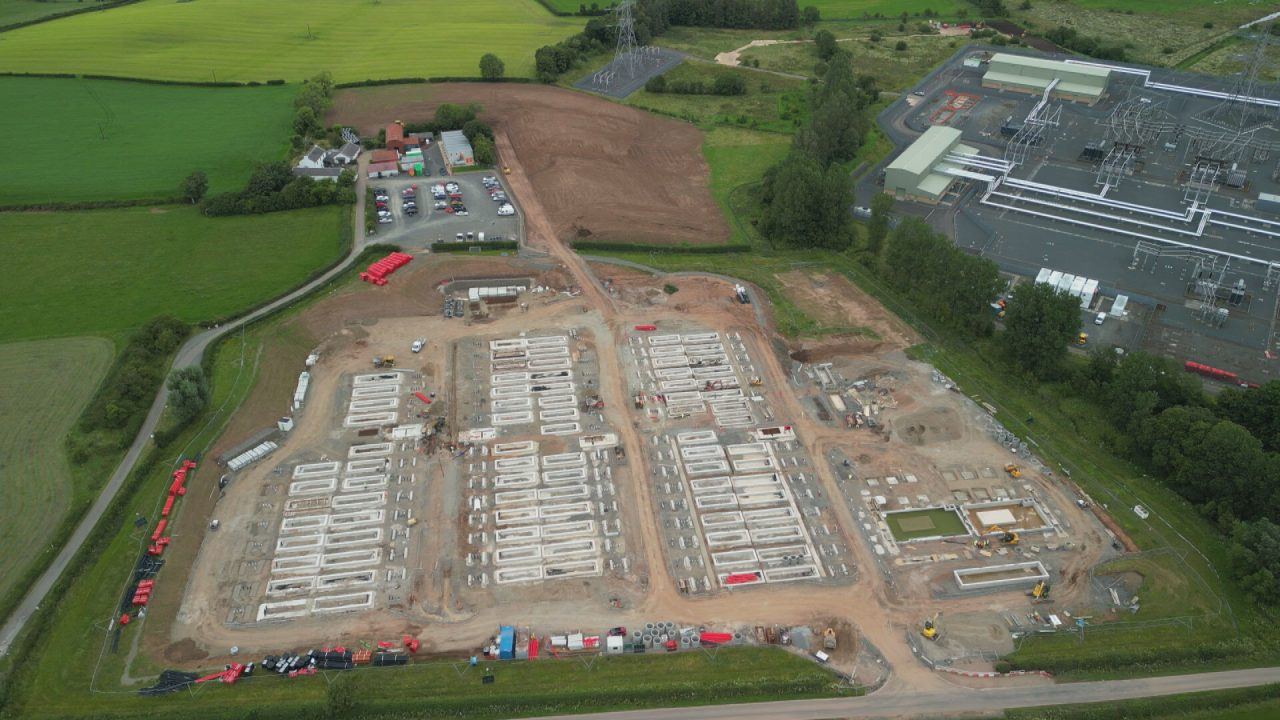
Campaigners are demanding an immediate moratorium on new battery storage developments, as a new report found projects already proposed could provide four times more electricity storage than will be needed by the end of this decade.
The demand came as Dr Kat Jones, director of the charity Action to Protect Rural Scotland (APRS), said that planning permission had been granted for battery storage sites “metres from 5,000-year-old prehistoric sites, in woodlands, and on prime agricultural land”.
She hit out as a new report from APRS insisted there is a “huge oversupply of battery storage” in the planning system.
The countryside charity acknowledged such sites “play an increasingly critical role” in the country’s energy infrastructure, allowing electricity generated by renewables to be stored in order to help balance supply and demand.
But the report said that when it comes to Battery Energy Storage Systems (BESS) Scotland has four times more capacity in the planning system than the maximum required by 2030 and 3.4 times more than the maximum needed by 2050.
While research suggests that between 5.9 and 6.4GW (gigawatts) of BESS storage is required by 2030, rising to between 6.4 and 7.6 GW by 2045, data showed that projects with a total capacity of 24.8 GW were in the planning process by June 2025 – with projects with 13.5 GW of storage capacity already given the go-ahead.
The APRS report noted: “Consented capacity is increasing rapidly as there is a trend for applications for larger battery storage sites.
“The number of applications for battery storage in Scotland is increasing year-on-year with 2025 looking like it will exceed the previous maximum of 2024.”
Meanwhile, the period April to June 2025 saw the joint highest number of applications for such projects of any quarter, with 31 BESS developments submitted for approval.
The report added that the Scottish Government’s Energy Consents Union has “never refused an application for stand-alone BESS”.
APRS director Dr Kat Jones said: “We already have planning permission for three times as much battery storage capacity as we need, but the applications keep coming in, and they keep getting consented. This has to stop.”
She added: “Developers must see large battery storage as a complete walk-over for planning permission. And it is. We found that no application for a large stand-alone battery storage site has ever been refused.
“We have seen them permitted on green belts, metres from 5,000-year-old prehistoric sites, in woodlands, and on prime agricultural land.”
Dr Jones demanded: “We need an immediate moratorium on battery storage projects.”
APRS also wants to see councils make the decisions on whether battery storage projects should get the go-ahead – saying this is in line with what happens in England and would also “ensure better local democracy and decision-making”.
The Scottish Government is also being urged to introduce national standards on battery safety “to ensure safety for communities, workers and the environment” and for the Scottish Fire and Rescue Service (SFRS) to be made a statutory consultee for all BESS applications.
Dr Jones also insisted: “We need a plan that will show where the battery storage is needed and where it can be most appropriately sited, rather than this free-for-all we see at the moment.”
She added that the “current slapdash approach is no good for getting the infrastructure we need in the right place” and is also “terrible for communities fighting bad proposals”.
As it stands, Dr Jones said that so far only a “tiny proportion” of battery storage sites are proposed for brownfield land which has been previously developed, adding: “The irony is that many of the locations that are best placed to connect to the grid have plenty of brownfield sites nearby.
“We are concerned that the scattergun approach to consenting thus far could actually prevent us building a network of energy storage of an appropriate capacity and in the most appropriate locations.”
A Scottish Government spokesperson said: “Battery storage will play a role in the future energy mix of Scotland as it offers fast-responding, dispatchable power when required to provide resilience to households and communities.
“Any potential impacts on communities, nature and cultural heritage, including the cumulative effects of developments, are important considerations in the decision-making process.
“All applications are subject to site-specific assessments and our planning and consenting systems ensure that local communities can always have their say.”
The government said it intends to publish further planning guidance on BESS sites this winter.
Follow STV News on WhatsApp
Scan the QR code on your mobile device for all the latest news from around the country