 Adobe Stock
A new night-time economy commission wants to establish Glasgow as a 24-hour city, with plans to improve transport and perceptions of safety after dark.
The city has opted for the “collaborative approach” provided by a commission rather than appointing an individual to a ‘night czar’ or ‘night mayor’ position.
Chaired by Sub Club managing director Mike Grieve, the expert panel will be supported by a night-time economy manager after Glasgow City Council approved funding for the role.
An early focus of the commission will be to develop an action plan to deliver on the findings of a recently-commissioned Nightshift Glasgow strategy.
That vision includes improving safety perceptions to make Glasgow more welcoming after dark, enhancing post-6pm transport quality and quantity, providing more lighting and protecting the city’s UNESCO-recognised music scene.
Speaking at a launch event in Arthouse Hotel on Monday, council leader Susan Aitken, SNP, said the commission, which would be “representative of the wider industry in all its diversity”, will feed “directly into the night-time economy manager”.
The manager, who has yet to be recruited, will be tasked with “making sure that it is not just a talking shop” but delivers real improvements.
As well as Grieve, the commission includes Fiona Ellis, from DF Concerts, Katie Duffy, head of art and music at Glasgow Life, and Stephen McGowan, head of licensing at TLT LLP. Members will also come from stakeholders in the sector, like Music Venues Trust, and community interest groups.
A commission and a night-time economy manager were recommended by the Nightshift Glasgow strategy, which was produced through a sub-group of the city centre taskforce, a public-private partnership, and sets out 50 areas for action.
Grieve, who chaired the sub-group and is also chair of the Scottish Night Time Industries Association, said they have already seen “some tangible results”, as the subway is set to open later and the group has managed to “influence the debate” on non-domestic rates, highlighting the “unfairness of the current system”.
Cllr Aitken said Glasgow’s approach to the hospitality industry had been “incredibly dated” when she first became leader in 2017, with a “sense that people going on a night out had to be regulated”. She believes the creation of the commission – a “dedicated champion to push for change” – is a watershed moment for the city.
“No one can possibly underestimate the importance of our night-time offer to Glasgow, whether that’s culturally, socially or economically,” she said.
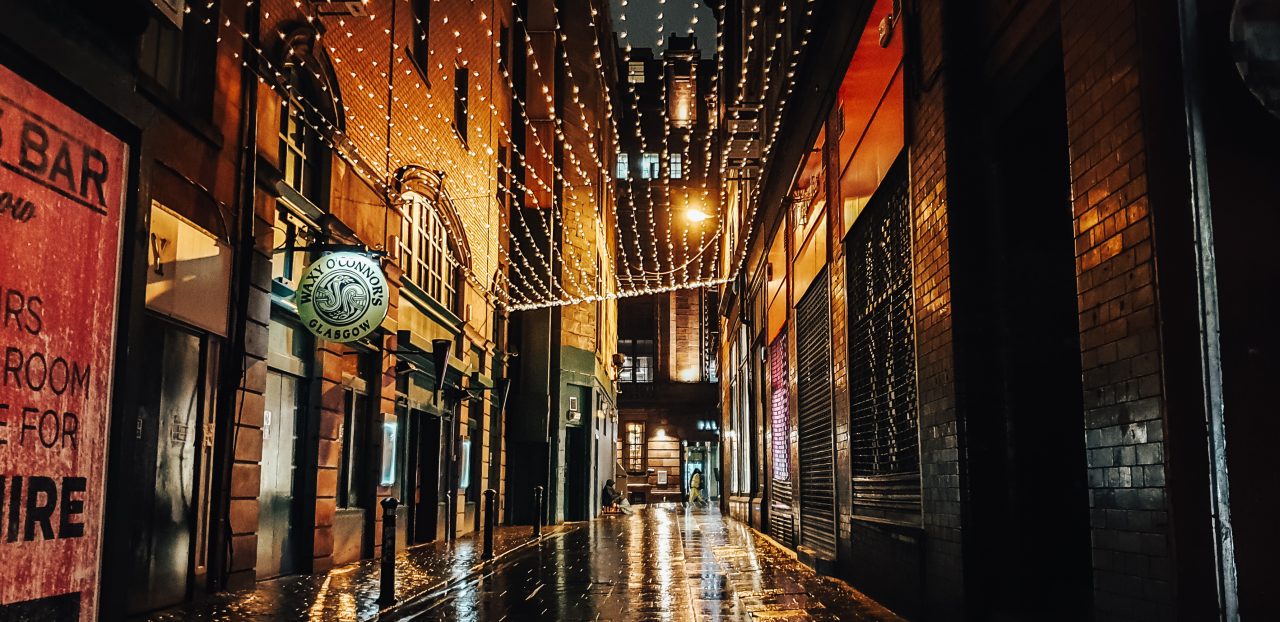
Areas of action in the Nightshift vision include improving safety in the city centre, suggesting “unsafe” lanes could be targeted with a city centre-wide programme using sound and light to create a laneways trail.
Cllr Aitken said the council would be willing to give “a wee bit of financial help” to owners who put forward “clear proposals” to develop private lanes.
The strategy also suggests an independent assessment of demand for night buses and a review of train services. It proposes that an extra service around 1am could serve a large proportion of users, particularly older people who do not want a very late night out.
Nightshift states that while there are “competing arguments” over taxi and private hire provision in the city, it is “clear for many the current system does not service the night-time economy as well as it should”.
Glasgow’s licensing committee is set to consider an independent review of its overprovision policies in the coming months. Currently, the number of taxis is limited to 1,420 and private hire cars to 3,450.
Cllr Aitken said the decision will ultimately be for members of the licensing committee, but she “would lean towards the view of the night-time industry”.
“I think we could do with lifting that cap, certainly raising it even if we are not scrapping it all together,” she said.
Nightshift was developed by night-time economy experts MAKE Associates. Its vision is that, by 2030, Glasgow will “shine as a global 24-hour city centre where night-time diversity, culture and innovation meet; connected by seamless transport and with vibrant and beautifully lit public spaces after dark”.
Ali Turnham, from MAKE Associates, said there is “incredible stuff going on in Glasgow” but it “needs a bit of guidance and strategy”.
“When I come here, I feel energised on the street, I get a feeling from the city which isn’t really like anywhere else I’ve ever been to,” he added.
“It has a unique identity, and that identity comes out at night in particular.”
Follow STV News on WhatsApp
Scan the QR code on your mobile device for all the latest news from around the country