
After nearly a week of heatwave conditions in many areas, including SW19, is it a historically hot year for Wimbledon?
How hot has it been at Wimbledon?
We’re currently on heatwave number three in as many months.
As the temperature climbs to 35-36C or more again on Friday, it’ll mean we’ve had more days of 35C + than any other year to date. We’re not even halfway through the summer.
This latest heatwave has coincided with the start of Wimbledon and is due to last into the finals weekend, with the hint of a slight breeze after the exceptionally calm and dry conditions of late.
Is this Wimbledon’s hottest tournament ever?
It’s certainly one of the hottest on record for the world-renowned tournament, but we won’t know for sure if it is the hottest ever until the weekend.
Recent climate analyses indicate that average temperatures during Wimbledon have increased by about 2.5°C since 1970.

The highest ever recorded temperature at the tournament was 35.7C on 1 July 2015. Last year, we had our hottest first day of Wimbledon on record.
Temperatures peaked at 34.5C (35C) on Thusday at nearby Kew Gardens.
The Met Office do not have an official weather observation site at Wimbledon itself, and rely on sites nearby.
In recent years, Wimbledon has used an on-site team supported by MetéoFrance, the national weather provider of France.
It’s also worth noting that all temperatures are taken in the shade for consistency. If you factor in direct sunshine, add around another 10C for those without shade on Centre Court.
The Centre Court roof provides shelter from rain and, for longer matches, light when it fades, but not air conditioning – something we’ve heard all about during the World Cup tournaments in huge US stadiums.
If it’s already hot and humid outside when the roof closes, the humidity inside may initially rise due to the people and the enclosed air, but the ventilation and dehumidification systems are designed to counteract this.
What does this heat mean for players?
A report on Grand Slams by Climate Central found that an increased number of hot days has resulted in tournaments introducing heat policies to protect players.
This includes guidelines such as Wimbledon’s heat rule that allows a 10-minute break when the heat stress index is at or above 30.1C. The heat stress index combines air temperature, humidity, and surface temperature, rather than using air temperature alone. It was initially introduced in 2015 and has been refined.
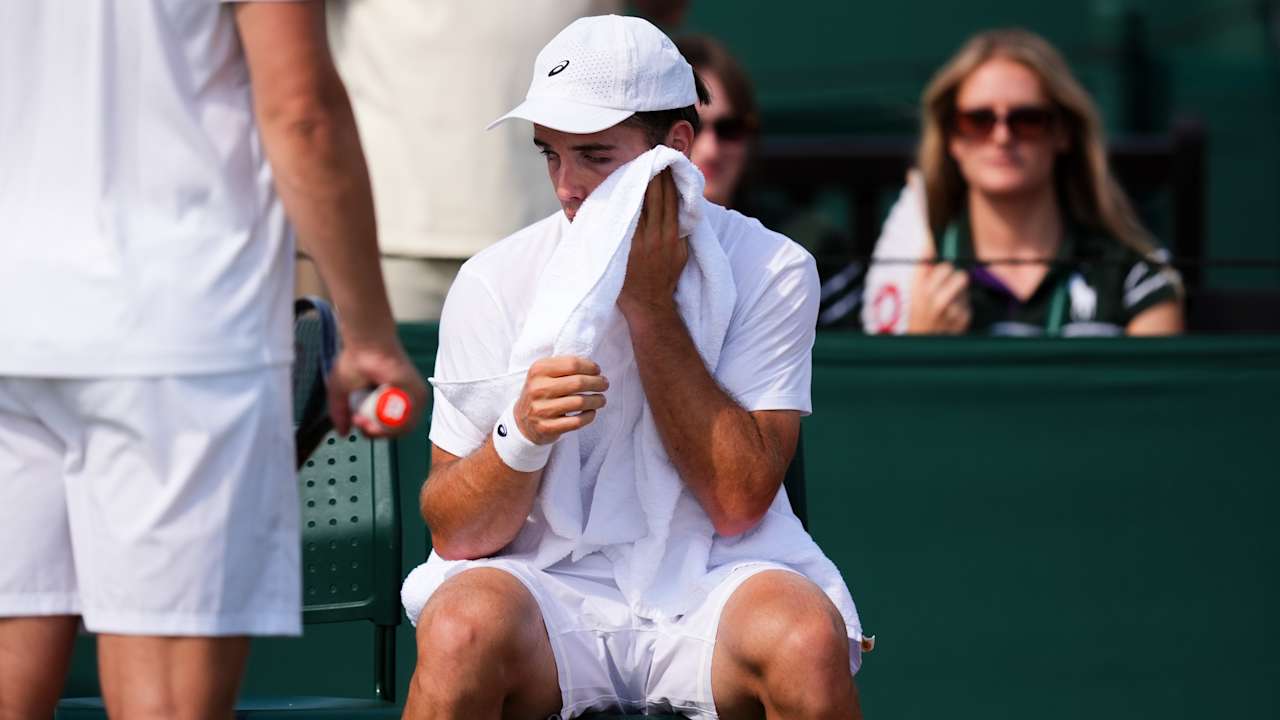
The heat rule does not apply if matches are played with the roof closed on Centre Court or No 1 Court as the indoor environment is climate-controlled. It also does not apply to doubles matches.
The heat stress index is measured 30 minutes before play, then again at 2:00 pm and 5:00 pm.
This year’s extreme heat also affected spectators, with several matches briefly interrupted because fans needed medical assistance in the stands, highlighting that conditions can be challenging for everyone.
Follow STV News on WhatsApp
Scan the QR code on your mobile device for all the latest news from around the country