 PA Media
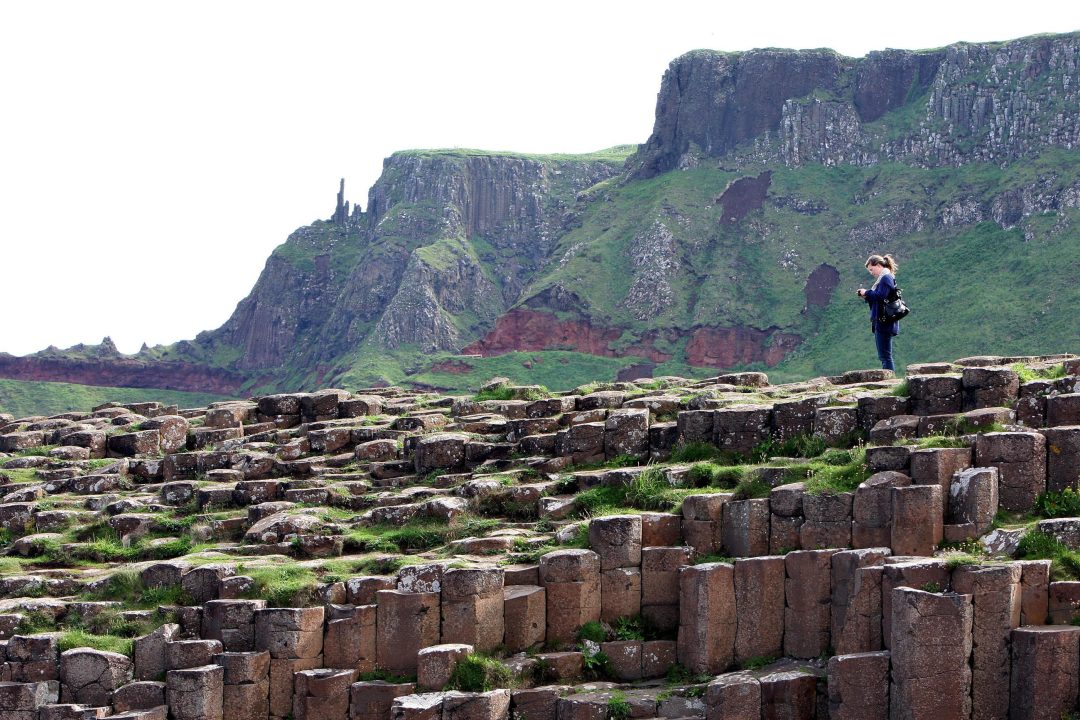
Scientists have made a new discovery about the history of the Giant’s Causeway rock formation.
New research has revealed that Northern Ireland’s volcanic past, which created the Causeway’s distinctive 40,000 basalt columns, happened over a much shorter period than previously thought.
It was discovered that volcanic events around the region formed rocks, including the Causeway, in just 5.5 million years – eight million years less than previous estimates.
Dr Simon Tapster, geochronologist at the British Geological Survey (BGS), said: “Fundamentally, what we’ve done is by piecing together this tapestry of volcanic rocks all across the North Atlantic, but focusing on Northern Ireland, we have been able to reassess a major globally impacting volcanic event.
“In doing that, and in reassessing the timescales, we have shown that actually it occurred in a much shorter duration.”
The Giant’s Causeway’s distinctive landscape was formed during intense volcanic activity which forced molten rock up through cracks in the earth.
Thick lava flows then cooled, contracted and cracked, creating about 40,000 basalt columns.
Dr Tapster said the cutting-edge research by the Geological Survey of Northern Ireland (GSNI) and the BGS, has reconstructed a new timeline for volcanic activity across Northern Ireland.
It has allowed researchers to place the volcanic activity that led to the formation of the Giant’s Causeway within a much more precise global context for the first time.
The research has significantly updated the understanding of when specific volcanic events happened in Northern Ireland.
As a result, scientists can more confidently connect those events to activity and landmarks elsewhere, including Scotland.
It also connects the processes that caused the development of the Giant’s Causeway to a globally significant volcanic event seen in rocks as far away as Greenland about 60 million years ago.
The first lava flows of Northern Ireland’s Antrim Plateau were previously thought to have occurred millions of years before the Staffa basalts and the formation of Fingal’s Cave, but they can now be connected much more definitively as part of the same volcanic activity.
Researchers said it is the same for the Giant’s Causeway with formations on Rum, the Mourne Mountains, and magmatism in Skye.
Dr Tapster said: “By looking at the timescales and the high-resolution timeline, we’re able to match it up with various other locations, particularly in the Inner Hebrides in Scotland, the volcanics of Mull, Rum, the Isle of Skye, and taking a bigger view, looking at Greenland and the Faroe Islands.”
The research is part of a wider initiative at the British Geological Survey to improve the understanding of the UK’s geology through better quantifying geological time in the rocks around us.
Follow STV News on WhatsApp
Scan the QR code on your mobile device for all the latest news from around the country