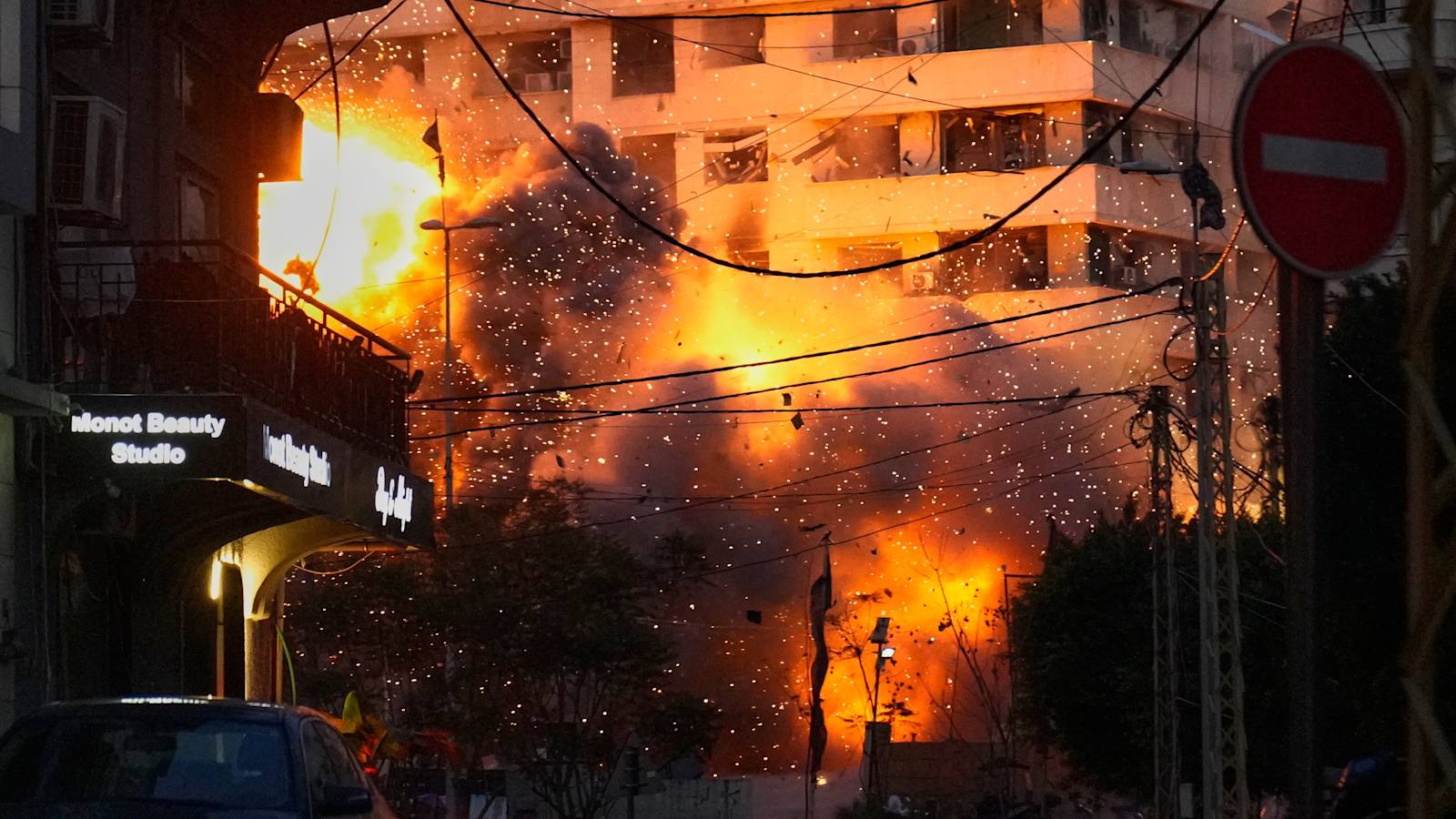
- Donald Trump has threatened retaliation after Iranian strikes on a major liquified natural gas production facility in Qatar.
- Kuwait said a drone attack set a second oil refinery ablaze in the small, oil-rich nation on Thursday.
- A summit of Gulf Arab countries and others ended with a renewed, unified call for Iran to halt attacks on its neighbours, saying they “cannot be justified under any pretext or in any way”.
- Brent crude oil, a benchmark for oil markets, was above $110 a barrel in morning trading, up more than 50% since Israel and the United States began their war with Iran on 28 February.
- More than 1,300 people in Iran have been killed. In Lebanon 968 have been killed, while 1 million (around 20% of the population) have been displaced. 15 people have been killed in Israel, while at least 13 US service members have also died.
- Three people were also killed in the occupied West Bank overnight by an Iranian missile strike, the Palestinian Red Crescent said.
Donald Trump has said the US would “massively blow up the entirety” of the world’s largest gas field if Iran attacks Qatar again.
The US president made his threat against Iran’s South Pars natural gas field on social media after Iranian missies struck the Ras Laffan liquefied natural gas (LNG) production and export facility overnight.
Iran said the attack on Qatar was in retaliation for an Israeli attack earlier on Wednesday on the South Pars gas field.
As attacks in the area continued into Thursday morning, a projectile hit a ship off the coast of the Ras Laffan industrial site, according to the United Kingdom Maritime Trade Operations centre (UKMTO).
The UKMTO reported said the ship’s crew was safe. It wasn’t immediately clear if the vessel had been deliberately targeted or potentially struck by falling debris as Qatar fired off missile interceptors at incoming Iranian barrages.
It wasn’t immediately clear if the vessel had been deliberately targeted or potentially struck by falling debris as Qatar fired off missile interceptors at incoming Iranian barrages.

The UKMTO also reported that a cargo ship off the United Arab Emirates’ eastern coast was hit by an “unknown projectile” on Wednesday night, igniting a fire aboard, adding that the ship’s crew had managed the blaze.
Energy markets have faced widespread disruption since the US and Israel’s war with Iran began on February 28, which has seen strikes carried out on energy facilities and other targets in oil-rich Gulf states allied with the US.
The Islamic Republic has also left the Strait of Hormuz, a major shipping channel through which one-fifth of the world’s oil travels, nearly impassable. Tehran has said the strait is open but is “closed to our enemies”.
Global oil prices rose on news of the South Pars attack due to fears of Iranian retaliation on Gulf energy infrastructure.
Trump said in his post that the US “knew nothing” about the attack, but a source familiar with the matter said earlier on Wednesday that Washington was informed about Israel’s plans to strike the gas field but did not take part.
Hours after the attack, authorities in Qatar said a ballistic missile hit the country’s key natural gas site, sparking a fire that caused “extensive” damage, and Qatar ordered some Iranian Embassy officials out of the country.

Writing on his Truth Social platform, Trump said that “out of anger for what has taken place in the Middle East”, Israel had “violently lashed out” on the South Pars gas field and stressed that Qatar “was in no way, shape or form, involved with it”.
“Unfortunately, Iran did not know this, or any of the pertinent facts pertaining to the South Pars attack, and unjustifiably and unfairly attacked a portion of Qatar’s LNG Gas facility,” he added.
“NO MORE ATTACKS WILL BE MADE BY ISRAEL pertaining to this extremely important and valuable South Pars Field unless Iran unwisely decides to attack a very innocent, in this case, Qatar.”
He wrote that if this happened again, “the United States of America, with or without the help or consent of Israel, will massively blow up the entirety of the South Pars Gas Field at an amount of strength and power that Iran has never seen or witnessed before.”
“I do not want to authorise this level of violence and destruction because of the long term implications that it will have on the future of Iran, but if Qatar’s LNG is again attacked, I will not hesitate to do so,” he added.
Qatar warned on Thursday that additional Iranian missile attacks damaged more liquefied natural gas sites in the energy-rich nation, “causing sizable fires and extensive further damage”.
Qatar Energy, the nation’s state-owned oil and gas company, said firefighters were working to halt the blazes and no one had been hurt so far.
Qatar is a key source of natural gas for the world’s energy markets. It already shut in its production earlier in the war, but extensive damage could delay Qatar in getting its supplies to the market after the Iran war ends.
As well as brent crude oil, which rose by around 7% to reach a significant price of $114 – around £86 – on Thursday morning, European benchmark natural gas prices also surged by about 20%.
Before this month, prices had not passed the $100 per barrel mark since July 2022.
Kathleen Brooks, research director at XTB, said the escalation in the conflict was “spooking the market” and traders were predicting “hefty losses for stocks” when stock markets open.
“This war looks far from over, and the energy crisis is shifting from a shipping crisis to a supply crisis,” she said.
“If Iran is targeting energy assets in the region, then the conflict gets more serious and the repercussions for a long-term energy price shock also start to play out in financial markets.”
She added that despite Trump’s calls for Israel and Iran to stop targeting energy sites, “It will take a lot of positive sentiment and news flow to calm energy prices today.”
New York-based think tank, the Soufan Centre, described Israel’s decision to attack the Iranian offshore natural gas field as “a clear expansion of the conflict”.
“Unlike oil storage depots that can be replenished and rebuilt on a shorter timeline, liquefied natural gas production facilities cannot be as easily repaired, especially against a backdrop of war,” it said.
“Extended timelines for repairs are a major blow to Iran’s economy, but above all else, they will be felt by Iranian civilians.”
The centre added: “Israel’s target selection in this war has heavily focused on the institutions, leaders and infrastructure within Iran that have been used for domestic repression, aiming to shape the conditions ripe for successful anti-regime mobilization by Iranians.
“It now seeks to inflict additional pressure on the regime by making the living conditions for civilians intolerable.”
Follow STV News on WhatsApp
Scan the QR code on your mobile device for all the latest news from around the country