
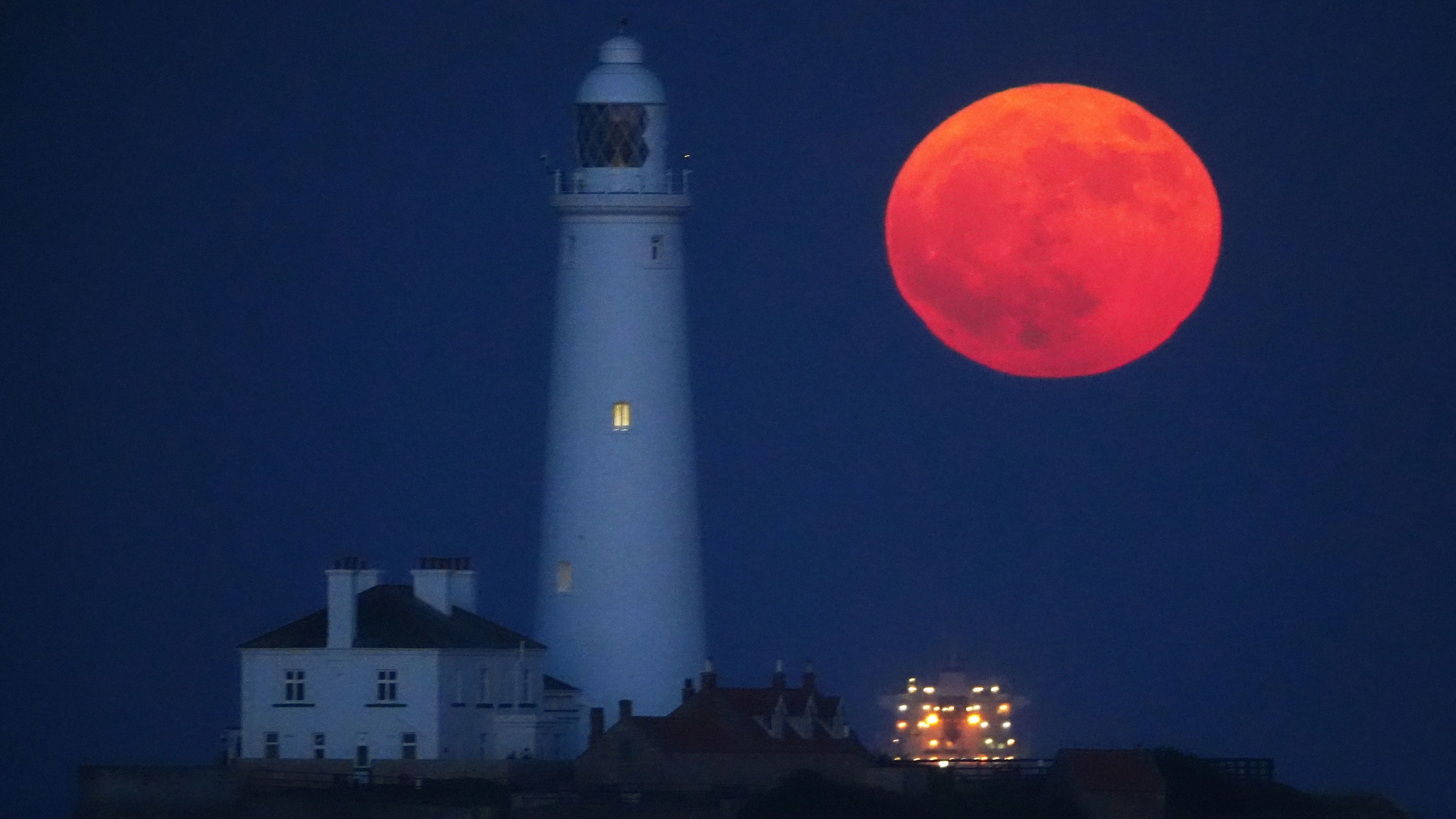
Skywatchers will get their first major watching event of 2026 with the Wolf Supermoon this weekend.
It is the first full moon of the year and will be the final supermoon in a streak of them dating back to October.
Glowing brighter and appearing slightly larger than average, it follows October’s Harvest Moon, November’s Beaver Moon and the Cold Moon in December.
Those wanting to catch a glimpse of the Supermoon will be hoping for clear skies. There won’t be another Supermoon in the sky until November.
What is a Supermoon?
The Moon’s orbit around Earth isn’t a perfect circle; at times, it’s closer to Earth and appears slightly larger and brighter, while at other times, it is farther away and appears smaller.
A Supermoon occurs when a full moon aligns with the Moon’s closest point to Earth, known as perigee.
At its farthest point, called apogee, the Moon looks smaller and dimmer. The Moon reaches both points during its 27-day orbit, but their exact distances change slightly over time.
“Supermoon” isn’t an official scientific term. But it usually means a full Moon that is very close to perigee. Supermoons happen about three to four times a year and often occur in a row.
At its closest, a supermoon can look up to 14% bigger and 30% brighter than the smallest full Moon of the year, though this difference can be hard to notice.
Supermoons can also cause higher-than-usual ocean tides because the Moon is closer to Earth.
When can I see the Wolf Supermoon?
Rising on January 3, it will be at its fullest at 10:03 GMT.
However, it will not be at its most impressive until it is closest to the horizon at evening moonrise.
Something that will happen at different times across the UK.
- 15:06 in Aberdeen
- 15.24 in Edinburgh
- 15.26 in Newcastle
- 15.45 in Liverpool
- 15:48 in Belfast
- 15:51 in Oxford
- 15.54 in London
- 16:03 in Swansea
Will there be any other supermoons in 2026?
There will be two other supermoons to come in 2026, in November and December.
There will also be a blue Moon in May – an event where two full Moons appear in a single month.
This means there will be a total of 13 full Moons in 2026, something that only happens once every couple of years and is the origin of the saying ‘once in a blue moon’.
How can you view the supermoon?
For the first skywatching event of 2026, you won’t need any specialist equipment, just a clear view of the sky. Arriving before moonrise will give you the best chance of catching the larger-than-usual moon.
However, binoculars and telescopes could help you catch the Moon’s craters and surface detail, as this will be the highest full moon until December 23’s full Cold Supermoon, which occurs just days after 2026’s winter solstice.
Where does the Wolf Supermoon get its name?
All full moons are given names, which are often linked to the time of year they occur. The names were given by Native Americans in North America in a bid to track the seasons.
There are some variations in the list, depending on where you look, as different tribes and settlers around the world created their own. However, the most common is the Farmers’ Almanac list, which we have adopted in the UK.
January’s wolf moon is named for the increased howling of wolves during this time of year, according to The Old Farmer’s Almanac.
Follow STV News on WhatsApp
Scan the QR code on your mobile device for all the latest news from around the country